Blog Tag: Strategy

  • Movies that can get your entrepreneurial spirits all pumped up

    Movies that can get your entrepreneurial spirits all pumped up

    While you search for motivation all around to get your brand growing, we say, slow down your boots a bit!

    The best ideas are born when one is relaxed. So, keep your entrepreneurial glasses in place while we give you an insight into how you can find inspiration from old and new movies. That’s right! Movies!

    There are some bright concepts out there…only if you know where to, or in this, what to look at. You get both entertainment and ideas as a package here. Wouldn’t you agree? 

    Now, enough small talks. We know you want to get right into the list, so, here goes…

    Crazy people – Honest marketing

    Honesty is good. It has been the moral goal of existence for so many years. But in marketing your brands? Will that ever turn up the sales?

    Emory Leeson is an advertising executive who is sick of romanticizing brands. In an epiphany, he tries his hand at advertising the truth. Crazy People shows the journey of Leeson and his success graph, which begins with the truth-telling outpour. This satirical comedy assesses the ways of advertising and why it ever settled for something false when it could do much better with the authenticity tag. The film, released in 1990, was way ahead of its time indeed. 

    Today, credible marketing tactics are highly applauded. If direct hard-hitting truths (like in the movie) may not work in favour, puns and sarcasm are equally enjoyed by the consumers. A brownie tip for the entrepreneurs out there!

    The lines we loved: “This honesty! It’s a terrific concept!”

    The Joneses – Word-of-mouth marketing

    Personal recommendations are quite exciting for people to explore. Just think about it! They tend to believe others who have actually tried out the product or have seen them consume it (at least).

    Does this sound like a marketing opportunity? Oh, yes!

    The Joneses is a movie about a fake family whose ultimate motive is to sell products as a unit to their posh neighbourhood. Every product they use, wear, or talk about is just pure marketing. The film moves to a reality v/s fake confrontation by the members, leading to unravelling the truth to the neighbours. However, the film shows us the possibility of rapid word-of-mouth marketing apart from many other cues.

    The Joneses is probably one of the first platforms to speak about ‘influencer marketing’ and ‘self-marketing’. A sure chance to boost up the sales in today’s scenario as well.

    A line we loved: “It’s called self-marketing. If people got you, they’ll want what you got.”

    Thank you for Smoking – Product placement 

    You may have noticed how before every movie there is a warning poster that says ‘Smoking is injurious to health. Smoking causes cancer.’ And the funny part? The whole movie would have glorified smoking. Are these mixed signals to the audience?

    Thank You For Smoking was released in 2005, starring Aaron Eckhart as Nick Naylor, a lobbyist (spokesman) for the Academy of Tobacco Studies. Talking his way out on the most controversial topics is his speciality. The film moves forward with the argument – that any product can hurt you under any circumstances, it’s up to the customer to choose their preferences. Even if this product eventually becomes your end. Naylor defends this statement everywhere he goes, also questioning the need for warning signs on cigarettes.

    Naylor is assigned a task to bring back the use of cigarettes into the movies. Product placements in movies are very common even today. But how would you convince the use of a deadly product and still win? The answer is confidence! And, of course, the power of communication.

    The lines we loved: “That’s the beauty of argument. If you argue correctly, you’re never wrong.”

    The Founder – Franchise marketing

    Being ambitious is the trait of every business-minded person. But how far would you go to achieve your goal?


    Released in 2016, The Founder tells the story of McDonald’s, the popular fast-food restaurant chain. The movie talks from the perspective of Ray Kroc, the businessman who led the restaurant chains to global success. When you can find ‘persistence’ and innovation on one side, a parallel narrative of how there is also greed and hypocrisy involved, cannot be denied (in the film). The Founder ultimately tries to convey to never settle or give up on your dreams while also knowing when to stop before the ambition becomes a toxic relationship. 

    From a franchise module to the importance of production speed to optimizing the customer experience and the power of brand names (phew!…that’s quite a lot), this movie packs a bunch of concepts to ponder for the success of a brand.

    The line we loved: “I’ll offer something as precious as gold. Do you know what that is? Opportunity!”

    The classic movie marathon

    While the above list were some hidden gems for entrepreneurs to explore, there’s no way we’re forgetting the classics either.

    The Social Network is Facebook’s backstory. It gives us the greatest push to go ahead with our goal even if it seems crazy or impossible at first. The Founder and The Social Network share a similar thematic narrative of contesting between being ambitious and holding the moral ground. 

    When you think of inspiration, what’s better than the Apple story? There are two film versions of Steve Jobs’ life and his journey with Apple. We recommend Steve Jobs – the one starring Michael Fassbender and Kate Winslet. Despite being kicked out of one’s own company, the strong grit Jobs’ had to re-enter Apple is sure to leave you motivated. What’s more…the consistent passion he had for his vision is truly something we can look forward to. 

    Apart from films, if you have the patience to sit through a well-made series, then we have a quick recommendation for that as well. Mad Men is an American Drama Series that narrates the life of a creative director (Donald Draper). People in marketing are bound to be a little crazy. This works in favour of Draper, who presents each of his ideas with confidence and sometimes ruthlessly. 

    And… there you have it! This list of movies is definitely worthy of your time, and who knows, they may spark some brilliant ideas for your business as well. 

    Let us know how it worked out for you!
  • Is competitive marketing healthy?

    Is competitive marketing healthy?

    “It’s a rat race out there!”

    “Don’t be just another sheep in the flock!”

    These are some common terms you focus on when you think of competition (competitive marketing), right? Every brand wishes to be unique in the market. They look for ‘that exceptional thing’ they can offer so they can stay ahead of the game. 

    Practically speaking, being unique comes off more easily than you think. You invent a whole concept when you say ‘unique’. On the other hand, discovering a special feature in your brand in a sea of similar fishes drives you to go way out of the box to present your products ‘unique’.

    Get the point? Well, let’s just say competition is complicated. But there’s more to it…

    What is competitive marketing?

    As the name explains itself, it’s a competition between similar brand positions. Each brand advertises itself as the best option in the market, with reasons to claim for the same. Now, you may think…what’s so different about that from normal advertising? Every brand wants to show they are the best. True! But the strategy used to market the products makes all the difference. 

    Brands using competitive marketing can only mean two things:

    • (either) they acknowledge their competitor in the game is strong 
    • (or) that the brand is extremely confident that they can take down their competitor by simply laying out facts. 

    And this is the basic blueprint of competitive marketing.  So, how does it work?

    It could be a friendly banter (rather publicly) between two or more brands, using taglines to counter the existing brand in the market or a conscious move without actually specifying any competitor details. 

    Comparative v/s Competitive

    When you understand the basics of competitive marketing, you realize that “It’s just similar brands brought together and claiming who’s best and why!” 

    Well, yes…but not ‘just’ so. 

    There is a natural urge to showcase a ‘comparison’ when we say competition. But that’s not exactly necessary here. When there’s a comparison, brands must make sure they do not address anything outside the boundaries permitted (legally). You cannot just announce “Brand A has defects, so choose Brand B”. If there aren’t any claims to support this, then it becomes an offense before you even get to the point of marketing. 

    Remember Hindustan Unilever Limited v/s USV Private Limited of 2021 catching wide attention because of their legal battle?

    Seba-vs-hul

    HUL’S bathing soaps (Lux, Dove, Pears) were orally mentioned in USV’s advertisements for their level of pH being higher than 5.5, which (as they mention) stands to be harmful to the skin. USV went on to indicate that using it would be equal to the effects of HUL’s another reputed (detergent) soap – ‘Rin’. 

    Now, this not only questions HUL’s brand projection but also USV’s reputation at stake. It literally compares the features and effects of another brand (blatantly) in the same field. 

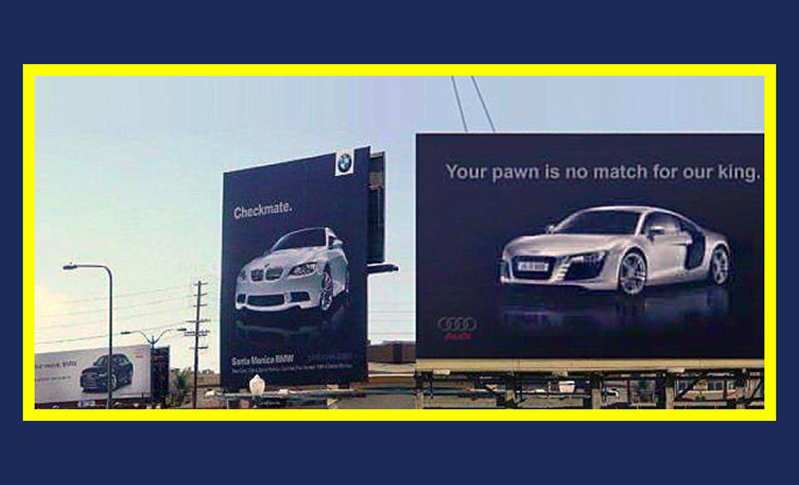
    Take BMW and Audi’s popular public exchanges. Both brands take it out on each other with taglines and better features from their previous remarks. As in, you know they both address each other but choose to play along…not backing down and posing as a real sport. 


    Their famous billboard series in Los Angeles created much hype on social media and led to a positive impression on the audience. The billboard battle was in the form of a chess game, which intrigued and most importantly, entertained the people passing by. In this case, comparative marketing had worked marvelously. Both the brands battled it out, keeping up with the reputation.

    And that’s how you play the match!

    The brand edge

    Competitive marketing, in general, aims to influence its brand weightage to the audience. Comparative (marketing) falls ‘under this’ and goes on to compare (like that wasn’t obvious enough) the attributes specifically. 

    In 2019, Amul had put up a campaign on social media about how their butter cookies actually contained butter and not oil fat. The post in itself showed another competitor (Brittania) and its butter percentage in their cookies. This was a huge blow as Amul attacked their main selling point. But this also stirred conversations among consumers about being aware of products they intake. That’s how a competitive strategy must play out.

    Amul


    Raising product awareness, backing up with solid proof, can get your brand to be differentiated from its other competitors, and lead to increased visibility. There is no gaslighting here, provided, of course, you move in the right spirit. A friendly exchange (like BMW and Audi), product (feature) awareness (like Amul’s) are some healthy competitive strategies that invite brand attention (and a bit of entertainment too). 

    Another note that brands usually forget is to not get swayed at the moment. You won’t believe how hard that is!

    When brands take up this style of marketing, they are consciously targeting their competitors or their specific features. So, that can naturally push them to go ‘mocking’ instead of ‘enriching’ with information. Or even in a more creative way, like using catchy taglines, it shouldn’t sound like you’re putting them off. That’s where the balance trips.

    So, back to the question –

    “Is competitive marketing healthy?”

    It can be… when you play your part with a pinch of salt. The message and audience addressed to, must be a priority rather than just jumping into the whole “let’s play it rough” mode. At the end of the day, the brand putting up such ads will also be affected. So, reputation will always be at stake for both (or more) brands involved. 

    Trying out innovative ideas can also work in their favor apart from simply laying down facts. Like the popular clash between The Hindu and Times of India, there was information conveyed while also moving strongly at each other. Although TOI started it, The Hindu finished off in style with the tagline “Stay ahead of the times”. Quite a smart move there!

    Brands can take up competitive marketing strategies with interesting and engaging creatives rather than looking down upon their competitors and making egoistic statements.

    There’s always room for experiments in advertising. Might as well embrace it!

  • Pride marketing: Are you on the right side of the rainbow?

    Pride marketing: Are you on the right side of the rainbow?

    Closing the doors on the peak month of Pride marketing season, the rainbow-hued campaigns walk out of the aisle with a little more than a few questions that begs for introspection. June – The month of Pride and a time for commemoration and respect for the rights of the LGBTQ+ (other than the 11 months where you should be doing it anyway) is known to give way to not just colourful, proud parades on the streets, but also in the advertising and marketing industry. 

    Months of what seems to be meticulous planning, innumerable meetings and campaign briefs all simmer down to an explosion of the VIBGYOR all over the brand, right until the 1st of July.

    However, one can ask – Is the campaign a reflection of the brand’s true purpose or just another Pride Party? 

    To begin with, Pride marketing campaigns in the current years have, in their own accord, turned a political movement into a seasonal endorsement of support. Everyone approves of the support; It is monumentary and a step-ahead in the cultural conversation it stimulates among the masses. 

    A second, not uncommon case is the use of beautiful rainbow-themed creatives that go with trending hashtags, non-committal representation and barely any real support shown beyond social media. This is called rainbow-washing. 

    How right is it then for brands to call their marketing campaign as a representation of being an ally? Let’s get into the details:

    By Picking a Stance

    In order to endear yourself to a community, the first requirement is to always pick a stance. The Pride community thrives on the power of a revolutionary political stance that aims to normalise the rights and lifestyles of LGBTQ+, along with raising a voice for acceptance of sexualities all around.

    Similarly, for a brand to be taken seriously in its endeavour to support the community, the right move is to pick a stance and stick by it. #TakePride by Target was one of the first brands to not let go of a manifesto in the face of flak. It was simple, yet actionable: to celebrate being one’s authentic self and making the effort to promote long-standing partnerships with groups and individuals supporting Pride.

    Support and Inclusion

    What shows on the page might not be what goes on behind the scenes. This is one of the common complaints faced by brands all year long. Consumers are aware to find distinction between performative and an authentic voice of support. Inclusion is the first step to exhibiting that. Introducing policies in the workplace that encourage a flourishing and safe environment for the LGBTQ+ have the potential of a resounding applause than in comparison to the brief asking to include the rainbow in brand identity.

    Education and consistency

    A platform as large as the media has the scope to instigate conversations, bring light to movements, call out blunders and create consistency in the distribution of a certain kind of news. Brands today are the driving force to normalising what might be considered taboo. 

    If brands like Tanishq could question the role of gender stereotypes, then what’s to say about global brands choosing to educate through actions?

    LGBTQAlphabet (2017), a short film released by Equinox took the initiative to orient the audience towards the diversity in the Pride community.

    Dunzo, in 2021 chose to support through their #hereforpride campaign aiming to support businesses run by the Queer Community.

    To have the community’s back is simple: letting go of normative rules and introducing change, be it through contributing to programmes, voicing movements or even increasing the base of recruiting sans the discrimination. It’s the little steps that make the lasting changes to ensuring a successful effort at Pride marketing.

    The eyes (and the campaign) thus need to focus on the rainbow and preferably not the pot of Gold!

  • Marketing Campaigns that fell flat

    Marketing Campaigns that fell flat

    In a world where Social Media and information sharing have become the norm. The Advertising Industry is adapting and crafting their art to pace with the evolving methods of brand presence. The amount of information that we access at such an unprecedented pace, causes us to see too many Ads. So much so that we lose track of brands and products that we loved so dearly once upon a time. Some would say that any marketing is good marketing. Yet, marketing experts and brands would differ in their opinion and strive to serve their consumers the best they can.

    Here are a few examples of marketing campaigns and Ads that failed to make an impact. You are sure to learn valuable lessons from their mistakes. And hopefully, get a head start at crafting successful marketing campaigns.

    1. Don’t Overdo – Dove’s Real Beauty Bottles

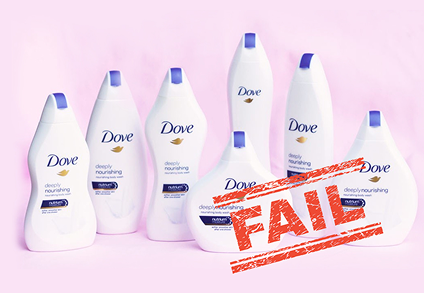
    Dove’s products have been in the market for a long time and they have been known to stroke positive beauty while advertising their products. However, the 2017 ad released for the Ad campaign ‘Real Beauty’ lost the winning streak. Dove’s ad in the summer of 2017 titled ‘Real Beauty Bottles’ got the attention of users from Social Media. With a tagline that beauty comes in all shapes and sizes, a video of manufacturing body wash bottles for every body type was made and broadcasted. Though the message seems to echo body positivity, many consumers didn’t buy in the idea and expressed their disappointment on social media.

    Image credit: The Drum

    The Marketeers seem to have overreached on this ad and missed connecting with the audience. Many consumers expressed that classifying people into shapes or sizes of a bottle wasn’t a good idea. Some even criticized the bottle’s colors as they were all white and didn’t accommodate all skin tones.

    Official promotional video via YouTube.

    A lesson to learn is that though your intentions might be right, what others perceive of it may not. Dove’s real beauty bottles were a classic example of how overdoing something tends to backfire. At these times, it is best to step into the customer’s shoes and see if you would buy the idea yourself.

    2. Leveling Up Never Comes With A Downgrade – OLX’s Breakup Challenge


    OLX’s 6-month breakup challenge was an intriguing attempt at asking the users to break-up with stuff that they  have not used for more than 6 months. The online marketplace took to twitter to introduce the campaign with a little bit of mystery. Which of course, got many users’ attention. OLX made a clever attempt at grabbing the people’s attention by locking access to the Ad only to those who shared the mystery post. This way, they were able to capture the engagement on the micro-blogging platform and make their brand presence felt.

    Though the campaign was successful in getting the people to talk about the ad. It didn’t however, perform a full cycle. With mediocre content used in the film, it failed to fan the flames of emotions amongst its users to take action. The persuasiveness message of the campaign seems to have died a slow and painful death as it couldn’t hold to its brand image of ‘Bech De’. Which was something that was portrayed in its other Ads with much clarity. Also, Olx has been known to set a higher benchmark with its content marketing, which the break-up challenge failed to achieve. And hence, though the impact on the audience was effective, the call to action was ineffective. Leaving the online marketplace back to square one.

    3. Think Glocal And Not Only Local – Cadbury Unity Bar

    A lot of times people misinterpret what we want to convey. One such instance was the marketing campaign by Cadbury India. Cadbury which had all the right intentions to display a diverse India through the Chocolate Bar faced severe criticism from its international consumers. The ‘Unity Bar’ was launched to mark the celebration of the 73rd independence day and reiterate the country’s display of unity in diversity. The ad campaign was promoted through different mediums. The front page of the economic times woke to a full-page ad that was printed in the native languages of Andhra, Maharastra, and Karnataka on different editions. The ad followed its copy that “The headline above is not a misprint. It is in Kannada/Telugu/Marathi. It says – Sweet things happen, when we unite.”

    The peak of the ad was that they had printed a Kannada headline in the Mumbai edition, Telugu headline in the Delhi edition, and Marathi headline in the Bangalore edition. This attracted a lot of social media hype to the brand and appreciated the efforts of their marketing strategy by some Indian users. However, some twitter users from around the world mocked the chocolate bar for being racist and a mockery of ending racism.

    The Unity Bar, a chocolate bar that stitched different shades of chocolate starting with white on the top and darker shades at the bottom, attracted many twitter users from around the world mocking its concept. Most of the comments mocked the bar on the lines of racism and disturbed their international brand image. Later, Cadbury UK took to Twitter to clear the misconception. A lesson to draw here is, to analyze the outcome at all levels. And if it’s a global brand, think globally and see how it pans out locally. Although the efforts to capture a few Indian hearts sure did get traction, the brand did take some amount of damage with this fiasco.

    4. Stop Digging When You Are Already In A Hole – Snapdeal’s Rebranding Campaign

    Another popularly known brand is starting to bite the dust after its ineffective marketing campaign. For online shoppers, it wouldn’t be a surprise that the e-commerce website hasn’t been at its very best lately. The company had received a lot of complaints about receiving the wrong products, like soaps instead of cellphones. Though the reason behind the decline in the number of users isn’t clear. The poorly performing business started going downhill when a lot of employees lost jobs to cut costs and save the business. Which in turn brought down the brand’s image leading to people using the e-commerce website less.

    The efforts to revive the brand added additional costs of around 200 cores to their already dipping figures. With the launch of the rebranding campaign ‘Unbox Zindagi’ during the Diwali season.

    Image via lighthouseinsights.in

    The company’s focus was to increase its sales in the fashion apparel segment and recover from the damage. Little did they know that recovering from downfall after burning a hole of 200 cores might not have been the best decision they made. To see if their rebranding efforts recover their damage is still in question as they are still struggling to climb up the ladder. Snapdeal spent an enormous amount of money for the rebranding project when their ledgers were already bleeding red. It is always important to use the big buck when you are at a better standing with your finances.

    5. Don’t Desensitize Serious Issues – Starbucks #RaceTogether Campaign

    In March of 2015, Starbucks launched their broadest initiatives ever. It started out as forum discussions in the Starbucks HQ in Washington and led to the Campaign ‘RaceTogether’. The campaign was aimed at initiating conversations and discussions around race with customers. The Baristas were asked to write #RaceTogether on every coffee cup that went out and were encouraged to have conversations about race. Although some would say that it was a great initiative. There are many that would disagree and criticize the fortune 500 company for being insensitive.


    Starbucks CEO Howard Schultz who was the man behind the initiative, faced severe criticism and the backlash of the marketing campaign. Customers took to social media and hurled insults at the brand for appropriating serious issues for economic gain. People got angry at how lowly, insensitive, and hypocritical the brand was. The people felt the brand was preaching about something that they themselves never practiced. And after repeated apologies from various heads of the management, the campaign was taken down.

    We will never know if the CEO genuinely felt the need to initiate this campaign to discuss and keep the conversation on race going. However, what we do know is to be a brand that is sensitive to social issues and not use them for any economic gain.

  • Aspects of logo design – Interesting facts about the Facebook logo.

    Aspects of logo design – Interesting facts about the Facebook logo.

    It’s always a surprise when something that we are so used to seeing or doing has changed. Sometimes we embrace the change and welcome it without a question and sometimes we don’t. Such has been the story of many brands and companies across the world. Change is a constant. Even in the entertainment industry, we see many television series make changes every season to catch up with the dynamically evolving world. One of the reasons we change things around is the need for freshness, a need to create something new. A need to free from the cycle of rut or boredom. One of the changes that is very evident in the world out there is the Facebook logo. You would find it interesting that such a change has happened over the past years, a few times. It is surprising when you track a company’s logo and read about its history and the changes.

    Fun Fact #1

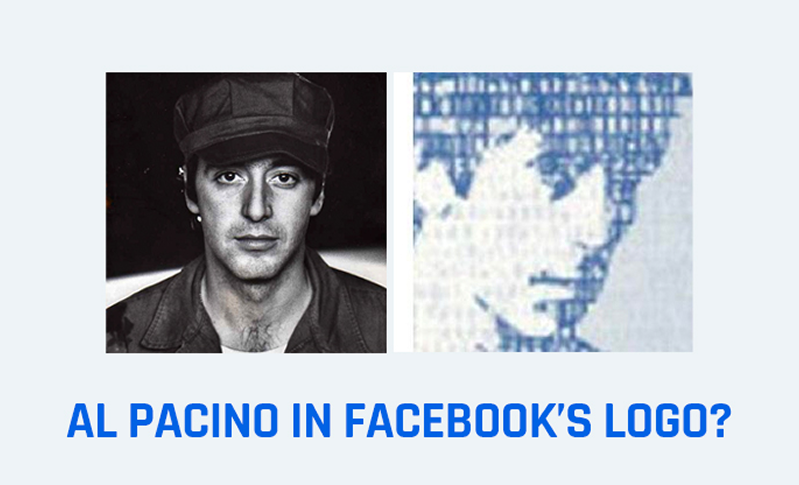
    Did you know that facebook’s famous logo started out as a face fogged by binary code? You’d wonder if it was one of the founder’s faces on it. Interestingly enough, it wasn’t. Andrew McCollum who was the classmate and a friend of Mark Zuckerberg designed the logo with the face of young Al Pacino in mind.

    Also, another interesting fact is that what we now call ‘facebook’ was called ‘Thefacebook’ back in 2004.

    via GIPHY

    How much is too much?

    After the local website meant for Harvard University gained popularity from other universities. And later to the public worldwide. The logo more or less remained the same with very subtle changes till date. This is because of the good old saying by John Hammond – character is the real foundation of all worthwhile success. In this case, it is the literal character. Jokes apart, as an established brand, people tend to recognize brands by their logo. And when that changes drastically, the brand becomes difficult to associate with, so try and keep it simple.

    Designing a logo

    Mike Buzzard, facebook’s logo designer explains, that the facebook logo was a typesetting of the Klavika font designed by Eric Olson. Which means that the logo they made wasn’t something that they created from scratch. Rather it was a clever use of something that was already present. Quite a helpful tip if you are into designing logos.

    Klavika by Eric Olson

    Colors

    If you have seen or used the social networking website – facebook, you will notice that it is mostly filled with the colors blue and white. This was an intentional effort by the team so that Mark Zuckerberg, facebook’s founder could see the website clearly. Because he suffered from a condition called deuteranopia. Which is a condition where only the shades of blue appear to be of rich essence and clarity over others. And hence the colors stuck.

    One helpful tip otherwise, is to use pastels and the color wheel when choosing colors for logo designs.

    Letter case

    The iconic use of lowercase letters by facebook adds a casual vibe to it. The use of lowercase in logos generally portrays an attitude of approachability. People are more inclined to approach a brand logo written in lowercase as opposed to others. To name a few examples amazon, flipkart, citibank and ebay, they all have their branding in the lowercase.

    Fun Fact #2

    You may have already known this fact, but it is worth the mention. The facebook logo travels the world to nearly 2 billion people at least once a month. Which is approximately the population of the Americas and Africa put together. And, most of them see it every single day without a miss. Making it one of the easiest recognizable logos of the twentieth century.

    Should I Design A Simple Or Complex Logo?

    The purpose of designing a logo is vital to understand if you need a simple or complex pattern. Be it for a small local firm or a global giant in the market, the need to design a logo will involve the purpose of the design. The design will vary depending on the purpose. Unlike other companies that spend tons of money on brand awareness and presence. The logo of facebook acts as a symbol for the company, so a simple typesetting design works in their case.

    Changing Or Redesigning A Logo

    Change is good when people welcome it. Last year, we saw the corporate office of the social media giant facebook, change the logos of itself and other apps associated with it. Though it took time to get used to the new logos of Instagram and facebook. We should take note that the change wasn’t too hard. So sometimes, a minimalist rendering of the logo will make the cut and sometimes it doesn’t. However, an important pointer or tip, is that you ask questions. Because some clients will ask for a complete makeover and some will just want to change little aspects of the logo, and depending on their requirements, you can take a call. Asking questions of clarity to clients most often clears your doubts and presumptions to give your best. Some examples of rebranding are best expressed when the changes are minimal.

    Shhhhh! A Little Secret or Fun Fact #3

    Finally, here is a little secret or fun fact. Did you know that the corporate logo of facebook has gone through some changes and made its way onto our smartphones? No, we’re not talking about its logo on the facebook App. But on WhatsApp and Instagram, if you haven’t figured it out yet. Next time you look at your phone to open these apps, pay attention to the start page of these apps.

    You’ll notice that a little facebook logo pops up at the bottom of the page. It’s a fun fact to brag about amongst your friends if they haven’t seen it already. Or even sound wise when you tell them that WhatsApp and Instagram are services owned by Facebook, Inc.

  • Building Your Startup into an Impactful Brand

    Building Your Startup into an Impactful Brand

    Carefully crafting and building a brand is challenging. What has worked for someone may not work for you. And you may be tempted to compare your brand to certain established giants. Yet, you know it has taken them years to reach where they are.

    These ‘giants’ have built a significant brand over the years. And that makes it essential for you to understand how to effectively build your brand. Here’s how you can start –

    Understanding Branding and Strategy

    Branding is distinguishing yourself from your competitors. It is clarifying what you have to offer, and what makes you the better choice. Building your brand involves representing who you are as a business. And how you want the world to perceive you.

    A brand exists in the minds of its customers, and that impression can have a drastic impact on sales. So, you can’t ignore it – not even in the initial days of your business. Your brand will evolve over time. But it is important for that evolution to have a direction.

    You will need to have a brand strategy, which is a formal plan to create a particular image of your business. This strategy includes specific and achievable long-term goals. It will communicate to the world what your brand is and the purpose it serves, along with what it aspires to be.

    Knowing your target market

    This is something you need to do before beginning the process of branding. Who is your brand for? Whom do you aim to reach with your branding? Whom do you want your brand to connect with? Gain a complete understanding of your target market/audience.

    Everything in your branding must be in sync with this. Your target market consists of your ideal customers. They should be able to understand it and associate with it. So in a way, they will be an important part of your brand identity.

    Creating a Brand

    The strategy will set the stage for your brand identity and image. The brand identity is how people identify and distinguish your brand. Your logo design, visual language, marketing collaterals, graphic style, tone of voice, consistency in communication, etc. will define your brand’s values and personality. And make it stand out from the crowd.

    Let’s take the example of Blackbucka company that has a dynamic and new-age brand identity. It is a famous brand in the freight industry, started by a group of passionate youths. Its products are driven by data science. Adams depicted the youthful aggression, along with showing what the company did, in their brand identity.

    Brand Identity design by AdamsCreation

    From just starting out to having 3,00,000 trucks and 60,000 fleet owners on its platform in under 3 years, the company has grown to another soaring level.

    Having a pleasing website

    Your website is an important marketing tool for your startup. It makes it easier for people to find your business online. While also helping your startup to establish credibility. Having a ‘pleasing’ website’ not only means one that’s aesthetically pleasing, but also easy to navigate and quick to load.

    Get the help of professionals and ensure that your website design and development is done well. Also, invest in a good hosting provider as well as efficient SEO.

    Using art and illustrations

    Think of the last time you saw a good painting, illustration, or animation. Didn’t it interest you? If it held your attention for a significant amount of time, you can use something similar for your brand.

    Art and illustration can engage audiences. Images can captivate them, and even spark their curiosity. Having animations in your marketing videos and illustrations on your website, will help to humanize your brand. And to differentiate it, while making your audience connect with it better.

    Selling your story and being memorable

    As a startup, it could be difficult to figure out who you are and what your brand aims to do right away. Yet, you need to use your brand identity and your company culture to create and sell a story. Recognize why your brand exists and make your customers connect with it.

    Also give customers something to remember. Experiences that are hard to forget, or good to reminisce. Use your creativity and defy their expectations. Be a memorable brand, right from the start.

    Paying attention to brand experience

    Marty Neumeier, author of ‘The dictionary of Brand’, defines brand experience as “all the interactions people have with a product, service, or organization; the raw material of a brand.”

    In an age where the internet and social media are on the rage, it is crucial to give importance to brand experience. By connecting and engaging more with your target audience, you can convert brand awareness to brand loyalty.

    So aim for a continuous engagement with your audience, one that doesn’t end with a sale. With every transaction and interaction, elicit good emotions and positive feelings in consumers. If you have an outlet, have a pleasant ambience design – one that aligns with your brand identity. Make your customers feel good, and worthy.

    It will shape the way people feel towards your business, product/service, and on the whole your brand. And that feeling is something you can always leverage, big time.

    Creating a solid brand for your startup, or rebranding your existing business, are demanding tasks. It is advisable to leave them to those who have been there, done that. And yet always think beyond those boundaries for every new project. The whole process goes a lot smoother when you are sure your brand is in safe hands.

  • 4 Rules to Build a ‘Common Man’s Brand’

    4 Rules to Build a ‘Common Man’s Brand’

    Let’s face it, no brand is ever meant for everyone.

    Some brands are portrayed as for youths, some for fitness freaks, for the common man, for the elitist, and so on. Even if a brand has a mass appeal, it will be more popular in certain target markets.

    Brands today want the most number of people to love them. Certain companies aim at making a “common man’s brand”, or a “people’s brand”. Where the common man likes and trusts it. Reason being, the common man is a large part of their target market.

    Let’s consider the example of Kenza TMT Steel bars, a brand that manufactures and sells steel bars in Kerala. It got a much-needed revamp, to give it a ‘people’s brand’ appeal and reinforce its reputation.

    Simplify

    For the common man to connect with your brand identity, it must be simple. They must know your brand, and understand what it is all about. But you don’t have to be everything for everyone. Create a distinct feeling and use it to shape every aspect of your brand.

    For example – If your product is somehow related to strength or power, bring that into your brand identity. Perhaps with a powerful-looking logo. Choose your brand colors wisely and accordingly. Your is the most recognizable part of your brand. It appears in every brand collateral. Have a cohesive and simplified identity for better brand recognition and recall.

    And remember: If in your marketing, you make claims about how good your product is, your brand also needs to look like it will live up to those claims. Only then, will the target audience to believe you.

    Be relatable

    If you want people to like you and trust you, they must be able to relate to you. Relatability is what makes them accept your brand, and acceptance is key to becoming a common man’s brand.

    An important aspect here, is how you portray your ambassador – if your brand has one. Kenza’s celebrity brand ambassador was earlier shown to be sort of an elitist. Well-dressed in formal clothing, he was talking about the product. But their target audience had simple, practical, money-conscious individuals. They could not relate to that character one bit.

    So we created a character one would often see in Kerala. He spoke in the local dialect and was a figure most people of the target market could relate to. A campaign was thoroughly planned before its execution by a production house. They followed up on our idea and created 4 relatable characters from 4 different locations of the state. This kindled a renewed sense of acceptance for the brand. It now identifies as being a people’s brand that is practical and justly priced.

    Film production by Dos caminos

    Translate features into benefits

    Your product/service could be great, but do consumers really need it? It may have a range of good elements, but can the consumers really gain from them? If yes, are you communicating it in the right way?

    The market cares a great deal about what your brand can do for it. So find out what your consumers need, what their pain points are, and what they are hoping for. Focus on how buying your brand will solve a particular issue for them.

    If you knew that your house is built with steel bars certified as Corrosion Resistant Steel (CRS), you would probably feel safer in it. Especially during the monsoon showers. Here, CRS is the feature, and you feeling safe is the benefit. This is what we mean by translating product features into user benefits. So that your brand gets a good amount of functional base.

    Be consistent

    If you want people to take your brand seriously, it needs to be consistent. The common man is quick to notice differences. If he likes what he gets, he can be very loyal. But if he does not, he may never come back – he is spoilt for choice, after all. So give him consistency and uniformity, and let him see that you are here to stay.

    Your messaging and brand identity need to be “on-brand” across all platforms. The feeling they get from your product, your logo, your advertising – needs to be consistent. This will help you establish credibility among your competitors. And also, gain the trust of your customers.

    The best way to instill consistency is by planning and making a brand guideline manual. And seeing that all collaterals are in sync with it. From vehicle branding, letterheads, T-shirts to the way the advertisements are designed. This will enable better brand recognition and recall too.

    Zig Zaglar once said that if they like you, they will listen to you; but if they trust you, they will do business with you. So when building a “people’s brand”, focus on becoming a trust-worthy brand. And minding the promises you make. Lastly, as the famous dialogue line goes, “Don’t underestimate the power of a common man!”.

  • Giving Fintech a new dimension, ToneTag explores sound waves to enable payments

    Giving Fintech a new dimension, ToneTag explores sound waves to enable payments

    “Why is it in India we get candies instead of balance cash?” asked a Singaporean friend to Kumar Abhishek. Like many of us even Kumar didn’t think much about ‘candy for a balance penny’ phenomena until his friend asked him for a reason. But after giving a thought to it, he looked at it as an opportunity. An opportunity in a place where some have advanced to cashless transactions and mobile wallets, while the rest are yet to even reach card transactions.

    Thus began the journey in March 2012, when Kumar along with his friend, Vivek started to research on ‘How to enable small payment through mobile.’

    Understanding the challenges

    Prior to their launch in 2013, the duo prepared a rough working model. They went around many cities and rural towns to get right model for their product.

    With the network and mobile connectivity problems, they realised the need to use an offline model of payment. They found that conventional offline mobile payments can be done via:

    Magnetic waves (where someone is swiping the card)
    Radio waves (where someone is using NFC or RFID)

    and thus they decided to build ToneTag, a contactless payment app that uses sound waves to enable offline, proximity-based contactless payments on any device.

    Kumar brings his extensive experience on Large Scale, Multi-Country, Core Banking Implementations, both on Mobile and Internet Banking areas. Prior to ToneTag, Kumar worked for Core Banking at Infosys and as a Senior Engineer with MindTree. Vivek on the other hand was pursuing his career in Chartered Accountancy under the mentorship of Yogesh Andlay. His experience with legal frameworks and company incorporation is an asset to the company.

    ToneTag in its initial journey has partnered with 14 Customers (banks, mobile wallets, and payment service providers) across India, Southeast Asia, Europe and Middle East. They have also raised a Series A funding of $1 Million from Reliance Capital Venture in July 2015.

    In the next two years, ToneTag aims to partner with 34 large format and mid-market brand stores, merchant acquirers, 14 large e-commerce companies for COD transactions, 26 Issuers with 80 million customers.

    Read More on how this technology can revolutionize the way we make our daily payments. You can also visit their website here, which is #YetAnotherAdamsCreation, to get in depth knowledge and avail their services.

    If you too are looking to get your business website designed that rightly communicates your brand message, then feel free to get in touch with us.

  • Brands of sustainability

    Brands of sustainability

    Sustainability has been doing the rounds in marketing for quite some time now. Today, consumers expect the sustainability tag in every product they buy or consume. Brands are striving to feature environmental-friendly attributes to appeal to a growing audience who follow a sustainable lifestyle. From buying groceries to luxury fashion, every brand is put under the lens. 

    Is ‘sustainability’ going to be another passing trend or is it here to define every space? 


    The Pandemic was one for a surprise…or rather a shock. It brought the world to a standstill, pulling the legs of every consumerist ideology. On a different note, this also opened a lot of doors for improvement – of choices and perception.


    With years of witnessing traditional advertising, one can surely tell that the world is now a more mature audience. Take a look at how brands are reacting to this change. 

    A sustainable start

    Evolution in advertising took a different spike in the last two decades due to the effects of the Pandemic. Consumers today, mostly millennials and Gen Z, are more conscious of what and where they spend their money. They do not want to settle for something just because it is colourful or fancy. 


    Most consumers seek a purpose behind each product to feel they are part of something big. They want to be responsible as a citizen and as a mindful human. All this was leading to the biggest trend wagon seen in years – Sustainability. 

    Of course, we have heard this term before. But never actually realised (stronger) that the world was changing rapidly. The masses, all of a sudden, had a lot of time to reflect on themselves and their lifestyle. This led the marketers to rethink and redefine their mission, vision, and motive to serve the new dynamics of their target audience. 

    Implementing sustainability

    What does it actually mean to be sustainable? Is it just green packaging and marketing bio-degradable products?

    Well, no. 

    A complete sustainable brand will have ethical sourcing right from the grass-root level. The development stages of the products will follow environmental-friendly methods, valuing the zero-wastage policy. The materials would be unharming for the Earth and ensure their supply chains follow the same. Some brands even go to the extent of devising a circular economy. 

    An establishing brand may have the added advantage to execute sustainability much easier than brands already out in the market. This will also lead the customer base to considerably shift from the age-old brands to newer, responsible ones. 

    Brands in action

    Existing brands realising the rising need to repurpose their stance on marketing have their baggage to look through. It wasn’t something that could be done overnight. The audience is now smarter than ever. Claiming sustainability and not living up to it would result in a backlash that most brands do not prepare for. 

    Some brands, understanding this possibility did test runs to evaluate their credentials. The simplest form of experimenting was through packaging. Brands like Dettol, Diageo, WOW Skin Science, Dabur, and Flipkart have come up with eco-friendly packaging options in recent times. A bunch of the biggie FMCG companies like HUL, Nestle India, Parle Agro, Coca-Cola, Pepsi-co, Marico, and Future Consumer have taken similar stances and pledged to completely settle for 100% recyclable packaging by the year 2050. 

    Small steps, Big gain

    Hesitant to move towards sustainable packaging options? Then, we’re here to tell you that it’s the right time to shift. The small change can make a big impact on customers, who will be reassured that choosing the respective brand was indeed a good choice. 

    Consumers do not mind paying an additional amount if they believe the brand is true to its cause. A brand’s promise to do better, moving forward, is what they tend to pursue. So, when age-old trusted brands show they are trying to make a change for the sake of the consumers and the environment, the product then sells for itself. 


    Take luxury brand Vivienne Westwood for example. The brand’s campaign – Ecotricity urged contemporary luxury brands to adopt green energy instead of fossil fuels for their productions. Or the popular brand Gucci, which collaborates with sustainable organisations to come up with eco-friendly collections. 

    These brands do not take away their original motive of selling luxury premium fashion. Rather, they adopt new segments within the brand to satisfy a group of the audience, showing that they try to improve with time. Sometimes, that’s all you need to do.

    Brands adopting sustainability practices (in one way or the other) are the ones that are going to stay longer in the market. A consumer’s lifestyle choices are backed up with reasonable awareness of brands and their effects. It’s the time of healthy transition and the brands that are smart enough to acknowledge this…stay!

    As statistics go, the only future for brands is to ‘Invest in our planet’.